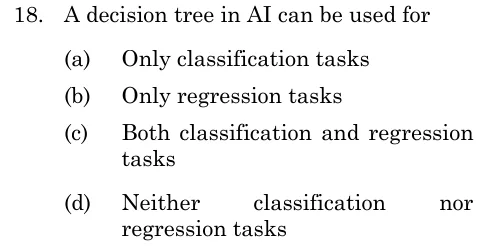
A decision tree in AI can be used for
- (A)
Only classification tasks
- (B)
Only regression tasks
- (C)
Both classification and regression tasks
- (D)
Neither classification nor regression tasks

A decision tree in AI can be used for
Only classification tasks
Only regression tasks
Both classification and regression tasks
Neither classification nor regression tasks
ANSWER
Option (c): a decision tree can be used for both classification and regression tasks.
Official answer: CSource: ISRO's final answer key of 15 May 2026
A decision tree splits the feature space with a sequence of tests on features, and each leaf holds a prediction.
If a leaf holds a class label (the majority class, or the class with the highest probability), the tree is a classification tree. Splits are chosen by information gain or Gini impurity.
If a leaf holds a real number (the mean of the training targets that reach it), the tree is a regression tree. Splits are chosen by the reduction in variance, that is, in squared error.
So the same tree-building method handles both kinds of target. This is the idea behind CART (Classification And Regression Trees).
Option (a) is wrong because regression trees exist. Option (b) is wrong because classification trees exist. Option (d) is wrong because a tree can be used for at least one of the two. Option (c) is correct.
KEY IDEA
A decision tree is a method, not a task. Class labels at the leaves give a classification tree; numeric leaf values give a regression tree.
WATCH OUT FOR
Thinking of decision trees only as classifiers because the usual examples (yes/no, spam/not spam) are class labels, and forgetting that a leaf can hold a numeric mean.
From the ISRO CS 2025 paper. Every question of this paper · The full paper (PDF, ISRO) · All 1 ISRO LDA, SVM & trees question, with notes