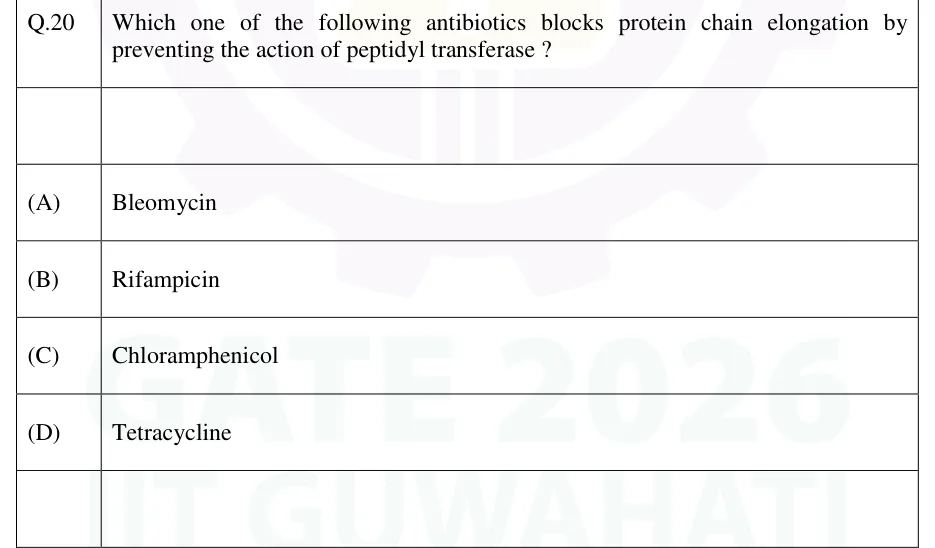
Which one of the following antibiotics blocks protein chain elongation by preventing the action of peptidyl transferase ?
- (A)
Bleomycin
- (B)
Rifampicin
- (C)
Chloramphenicol
- (D)
Tetracycline

Which one of the following antibiotics blocks protein chain elongation by preventing the action of peptidyl transferase ?
Bleomycin
Rifampicin
Chloramphenicol
Tetracycline
ANSWER
The correct answer is (C) Chloramphenicol.
Official answer: CSource: Official answer key, GATE 2026 BT (IIT Guwahati)
The question asks which antibiotic blocks translation elongation specifically by inhibiting peptidyl transferase, the ribozyme activity of the bacterial 50S ribosomal subunit that catalyzes peptide bond formation between the growing peptide chain and the incoming aminoacyl-tRNA.
(A) Bleomycin is an anticancer antibiotic that causes DNA strand breaks via free-radical generation. It acts on DNA, not on ribosomes or translation. Incorrect.
(B) Rifampicin inhibits bacterial DNA-dependent RNA polymerase, blocking transcription initiation. It does not act on the ribosome or on translation elongation. Incorrect.
(C) Chloramphenicol binds the 50S ribosomal subunit and directly inhibits peptidyl transferase activity, preventing peptide bond formation and thus blocking elongation. This matches the question exactly. Correct.
(D) Tetracycline binds the 30S ribosomal subunit and blocks binding of aminoacyl-tRNA to the ribosomal A site, preventing delivery of the incoming tRNA rather than inhibiting the peptidyl transferase reaction itself. Incorrect.
Only chloramphenicol's mechanism is inhibition of peptidyl transferase, so the answer is (C).
KEY IDEA
Peptidyl transferase is the ribozyme activity of the bacterial 50S subunit that catalyzes peptide bond formation; chloramphenicol specifically inhibits this step, distinguishing it from other translation-targeting antibiotics that act at different points (A-site tRNA binding, translocation, etc.).
WATCH OUT FOR
Confusing tetracycline (blocks aminoacyl-tRNA binding at the A site) with chloramphenicol (directly inhibits the peptidyl transferase reaction itself) — both act on the ribosome during elongation, but only chloramphenicol targets peptidyl transferase specifically.
From the GATE 2026 BT paper. Every question of this paper · Download the full paper · All 21 Gene expression questions, with notes