
IAE Academy

GATE 2020 BT Q.47: solution and answer

GATE 2020 · BTQ.47 · 2 marks · NAT

The amino acid sequence of a peptide is Phe-Leu-Ile-Met-Ser-Leu. The number of codons that encode the amino acids present in this peptide is given below:

Phe: 2 codons
Leu: 6 codons
Ile: 3 codons
Met: 1 codon
Ser: 4 codons

The number of unique DNA sequences that can encode this peptide is ____.
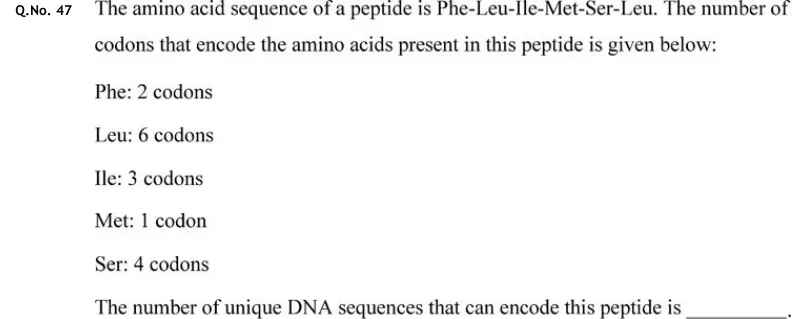
See the question in the paper

Answer and solution

ANSWER

The number of unique DNA sequences encoding this peptide is 864.

Official answer: 864Source: Official answer key, GATE 2020 BT (IIT Delhi)

  1. The peptide has 6 residue positions: Phe-Leu-Ile-Met-Ser-Leu, with Leu occurring at positions 2 and 6.

  2. Each position's codon in the DNA is chosen independently of every other position, so by the multiplication principle the total number of distinct coding sequences is the product of the number of codon choices at each of the 6 positions.

  3. Codon-count per position: Phe = 2, Leu = 6, Ile = 3, Met = 1, Ser = 4, Leu = 6 (second occurrence).

  4. Multiply across all 6 positions: .

  5. ; ; ; ; .

  6. Total number of unique DNA sequences encoding this peptide = 864.

KEY IDEA

Because the genetic code is degenerate, each amino acid position in a peptide can independently be encoded by any one of its synonymous codons. By the multiplication principle, the total number of distinct coding (DNA) sequences for the whole peptide is the product of the number of codon choices at every position in the chain, counting a repeated amino acid once per occurrence in the sequence.

WATCH OUT FOR

Treating repeated amino acids (Leu appears twice) as contributing only once, or adding the codon counts instead of multiplying them.

From the GATE 2020 BT paper. Every question of this paper · Download the full paper · All 21 Gene expression questions, with notes

More Gene expression questions