
IAE Academy

GATE 2020 BT Q.38: solution and answer

GATE 2020 · BTQ.38 · 2 marks · MCQ

Match sub-cellular organelles listed in Group I with their features listed in Group II:

Group I: [P] Mitochondrion, [Q] Chloroplast, [R] Nucleus, [S] Endoplasmic reticulum
Group II: 1. Single-membrane enclosed, 2. Double-membrane enclosed, 3. Maternal inheritance, 4. Endosymbiotic origin
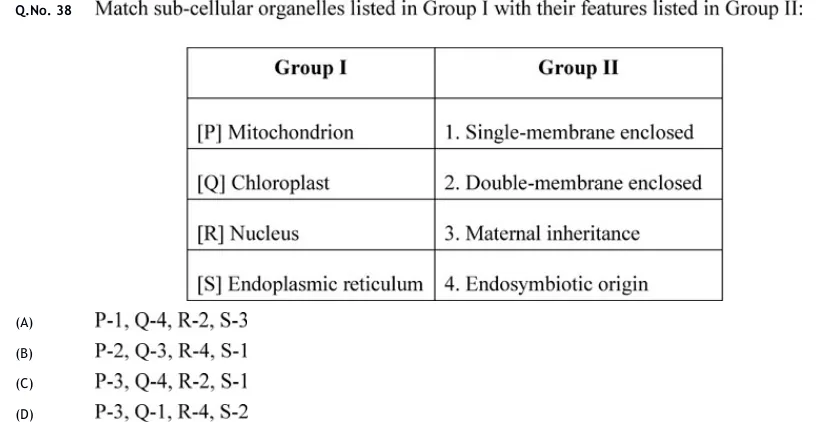
GATE 2020 BT question 38: A two-column table.Tap to open full size
Figure from the GATE 2020 BT paper. It is part of the question.
Figure description

A two-column table. Column header 'Group I' lists: [P] Mitochondrion, [Q] Chloroplast, [R] Nucleus, [S] Endoplasmic reticulum. Column header 'Group II' lists: 1. Single-membrane enclosed, 2. Double-membrane enclosed, 3. Maternal inheritance, 4. Endosymbiotic origin. Rows are aligned P-1, Q-2, R-3, S-4 by position but these are just the listed items, not the answer.

  1. (A)

    P-1, Q-4, R-2, S-3

  2. (B)

    P-2, Q-3, R-4, S-1

  3. (C)

    P-3, Q-4, R-2, S-1

  4. (D)

    P-3, Q-1, R-4, S-2

Answer and solution

ANSWER

The correct match is P-3, Q-4, R-2, S-1 — option (C).

Official answer: CSource: Official answer key, GATE 2020 BT (IIT Delhi)

  1. Nucleus (R) is enclosed by a double membrane (the nuclear envelope) but is not of endosymbiotic origin and is not itself an example of maternal (uniparental) inheritance, so its only applicable Group II feature is 2 (double-membrane enclosed): R-2.

  2. Endoplasmic reticulum (S) is part of the endomembrane system and is bounded by a single membrane, with no bearing on endosymbiosis or inheritance, so its only applicable feature is 1 (single-membrane enclosed): S-1.

  3. This leaves features 3 (maternal inheritance) and 4 (endosymbiotic origin) to be split between mitochondrion (P) and chloroplast (Q) in one of the two possible orders — biology alone does not force one order, since both organelles are double-membraned, of endosymbiotic origin, AND predominantly maternally inherited.

  4. Checking the four printed options against facts already fixed: option (A) wrongly makes mitochondrion 'single-membrane enclosed' (P-1); option (B) wrongly makes nucleus 'endosymbiotic in origin' (R-4); option (D) wrongly makes chloroplast 'single-membrane enclosed' (Q-1) and again gives the nucleus feature 4. All three are eliminated by a factual error.

  5. Only option (C) — P-3, Q-4, R-2, S-1 — is free of any such error and is consistent with R-2 and S-1 being forced, so (C) is the answer.

KEY IDEA

This is a one-to-one matching question (each Group II feature used exactly once), and two of the four rows have only one biologically valid feature each — solve those first, then use the printed options (not biology alone) to break the remaining tie between mitochondrion and chloroplast.

WATCH OUT FOR

Assuming there is one "textbook-clean" one-to-one mapping between organelle and feature on biological grounds alone. In reality, mitochondria and chloroplasts BOTH have double membranes, BOTH arose by endosymbiosis, and BOTH are predominantly maternally inherited in most organisms — so P and Q cannot be split between "endosymbiotic origin" and "maternal inheritance" by biology alone. The split is only fixed by first solving the two unambiguous rows (R and S) and then using the four printed options to eliminate every internally inconsistent match.

From the GATE 2020 BT paper. Every question of this paper · Download the full paper · All 15 Cell biology questions, with notes

More Cell biology questions