
IAE Academy

GATE 2025 IN GA Q.6: solution and answer

GATE 2025 · INGA Q.6 · 2 marks · MCQ

Based only on the conversation below, identify the logically correct inference:

“Even if I had known that you were in the hospital, I would not have gone there to see you”, Ramya told Josephine.

  1. (A)

    Ramya knew that Josephine was in the hospital.

  2. (B)

    Ramya did not know that Josephine was in the hospital.

  3. (C)

    Ramya and Josephine were once close friends; but now, they are not.

  4. (D)

    Josephine was in the hospital due to an injury to her leg.
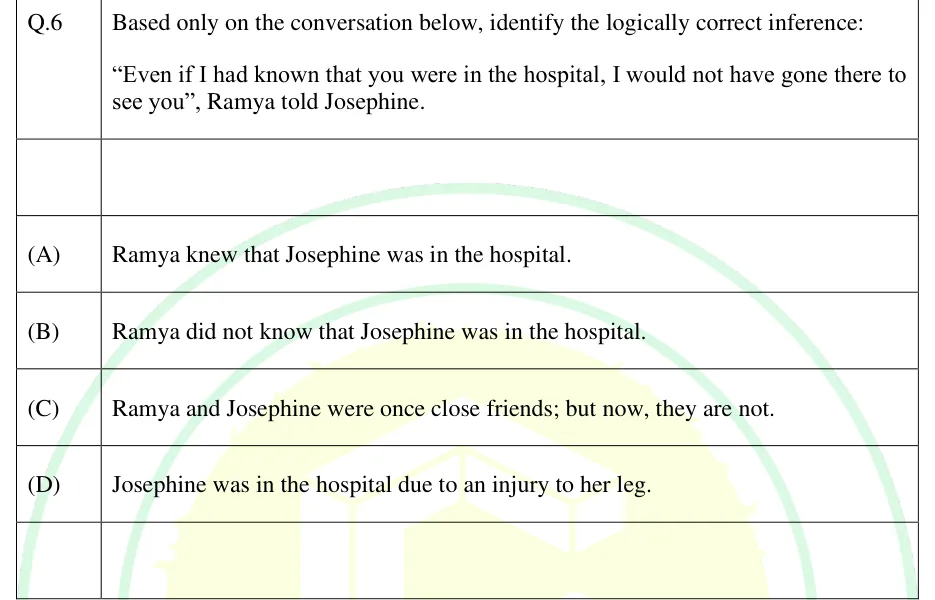
See the question in the paper

Answer and solution

ANSWER

The answer is (B): Ramya did not know that Josephine was in the hospital.

Official answer: BSource: Official answer key, GATE 2025 IN (IIT Roorkee)

  1. The sentence is a third conditional, also called a past counterfactual. It has the pattern if + had + past participle ("had known"), followed by would not have + past participle ("would not have gone"). This pattern describes an imagined past situation that did not actually happen.

  2. In a past counterfactual, the if-clause is contrary to fact. "If I had known that you were in the hospital" therefore tells us that Ramya did not know Josephine was in the hospital.

  3. "Even if" adds only that knowing would have changed nothing: Ramya still would not have visited. It does not cancel the contrary-to-fact meaning carried by "had known".

  4. (A) says the opposite of what the if-clause implies, so it is ruled out.

  5. (C) goes beyond the text. Refusing to visit might hint at a strained relationship, but the sentence never says the two were once close friends or that the friendship has ended.

  6. (D) adds a detail (an injury to her leg) that the conversation never mentions, so it cannot be inferred.

  7. The only inference the sentence alone forces is (B): Ramya did not know that Josephine was in the hospital.

KEY IDEA

A past counterfactual ("If I had known ..., I would not have ...") presents its if-clause as contrary to fact. So "had known" tells you the speaker did not know. "Even if" only adds that knowing would have made no difference to the outcome.

WATCH OUT FOR

Picking (C) because refusing to visit sounds hostile. The question asks for what follows from the sentence alone, and nothing in it mentions a past friendship. Another trap is reading "even if" as a sign that Ramya did know (option A). The past-perfect "had known" is what marks the condition as unreal.

From the GATE 2025 IN paper. Every question of this paper · Download the full paper · All 18 Reading questions, with notes

More Reading questions