IAE Academy

GATE 2026 CS1 GA Q.6: solution and answer

GATE 2026 · CS1GA Q.6 · 2 marks · MCQ

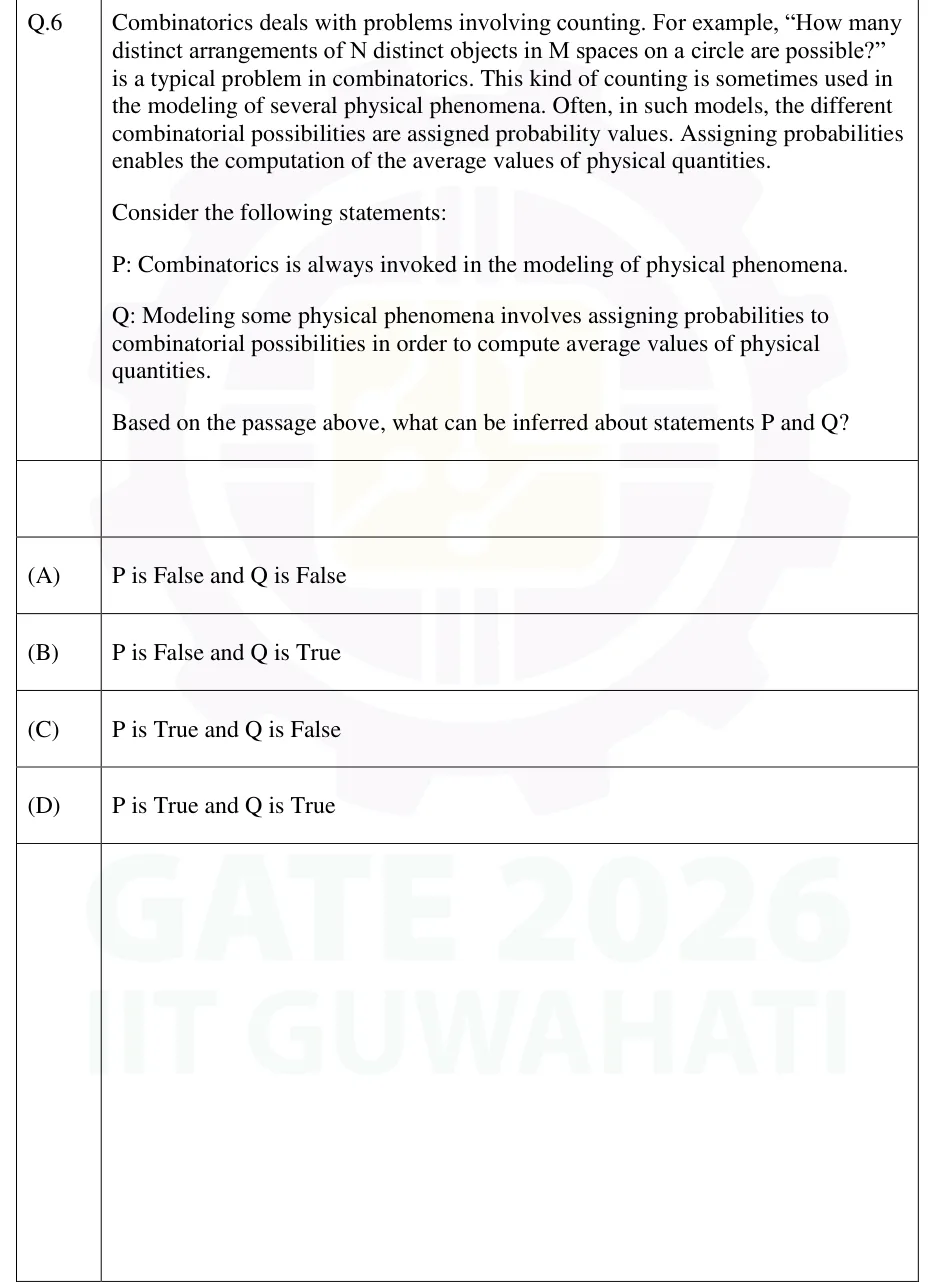
Combinatorics deals with problems involving counting. For example, “How many distinct arrangements of N distinct objects in M spaces on a circle are possible?” is a typical problem in combinatorics. This kind of counting is sometimes used in the modeling of several physical phenomena. Often, in such models, the different combinatorial possibilities are assigned probability values. Assigning probabilities enables the computation of the average values of physical quantities.

Consider the following statements:

P: Combinatorics is always invoked in the modeling of physical phenomena.

Q: Modeling some physical phenomena involves assigning probabilities to combinatorial possibilities in order to compute average values of physical quantities.

Based on the passage above, what can be inferred about statements P and Q?

  1. (A)

    P is False and Q is False

  2. (B)

    P is False and Q is True

  3. (C)

    P is True and Q is False

  4. (D)

    P is True and Q is True

See the question in the paper

Answer and solution

ANSWER

Option (B): P is False and Q is True.

Official answer: BSource: Official answer key, GATE 2026 CS1 (IIT Guwahati)

  1. Statement P says combinatorics is always invoked in modeling physical phenomena. The passage says only that this kind of counting is "sometimes used in the modeling of several physical phenomena". "Sometimes" does not support "always", so P cannot be inferred. P is False.

  2. Statement Q says that modeling some physical phenomena involves assigning probabilities to combinatorial possibilities in order to compute average values of physical quantities.

  3. The passage says that "often, in such models, the different combinatorial possibilities are assigned probability values" and that "assigning probabilities enables the computation of the average values of physical quantities". If this happens often, it happens in some models. Q is supported, so Q is True.

  4. P is False and Q is True, which is option (B).

KEY IDEA

In inference questions, compare quantifier words. "Always" is stronger than the passage's "sometimes", so it is not supported. "Some" is weaker than "often", so it is supported.

WATCH OUT FOR

Treating the passage's topic as support for a universal claim and choosing P True, or rejecting Q because it does not repeat the passage's word "often".

From the GATE 2026 CS1 paper. Every question of this paper · Download the full paper · All 35 Reading questions, with notes

More Reading questions