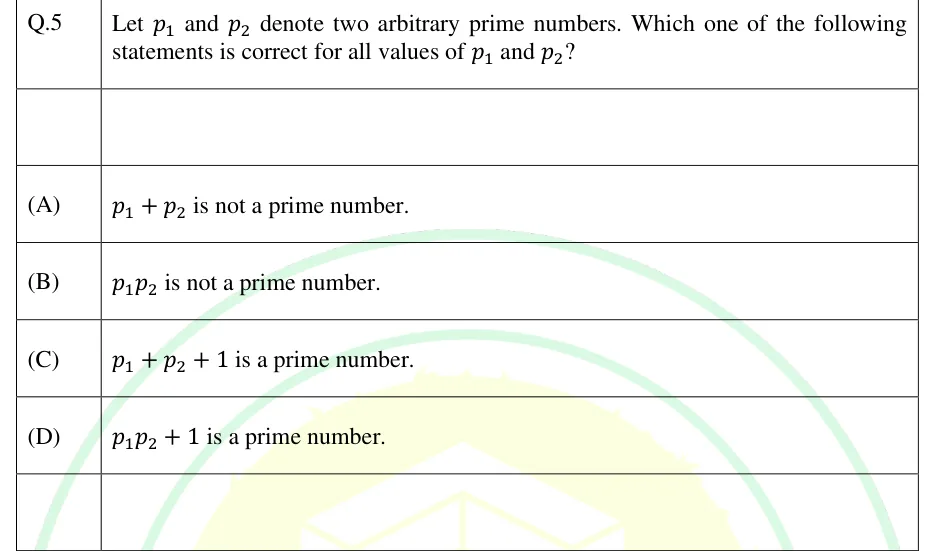
Let and denote two arbitrary prime numbers. Which one of the following statements is correct for all values of and ?
- (A)
is not a prime number.
- (B)
is not a prime number.
- (C)
is a prime number.
- (D)
is a prime number.

Let and denote two arbitrary prime numbers. Which one of the following statements is correct for all values of and ?
is not a prime number.
is not a prime number.
is a prime number.
is a prime number.
ANSWER
(B): is not a prime number. The product of two primes always has as a divisor strictly between and itself.
Official answer: BSource: Official answer key, GATE 2025 IN (IIT Roorkee)
The statement has to hold for every pair of primes, so one counterexample is enough to rule an option out.
(A) Take . Then , which is prime. So (A) fails.
(C) Take . Then , which is not prime. So (C) fails.
(D) Take . Then , which is not prime. So (D) fails.
(B) A prime has no positive divisors other than and itself. is divisible by , and : the first inequality holds because , and the second because gives . So has a divisor other than and itself, which makes it composite. This covers as well, since has the divisor .
So is never prime, and (B) holds for every pair of primes.
KEY IDEA
"For all values" means one counterexample kills an option. Test small primes, including , the only even prime. Prove the option that survives from the definition: a product of two numbers each at least is always composite.
WATCH OUT FOR
Two traps here. For (A), students often think "the sum of two primes is even, so it is not prime", which forgets the prime (). For (D), students often pick it because is prime, which half-remembers Euclid's argument. Euclid's argument only shows that has a prime factor outside , not that it is prime itself, and is a counterexample.
From the GATE 2025 IN paper. Every question of this paper · Download the full paper · All 58 Numerical questions, with notes