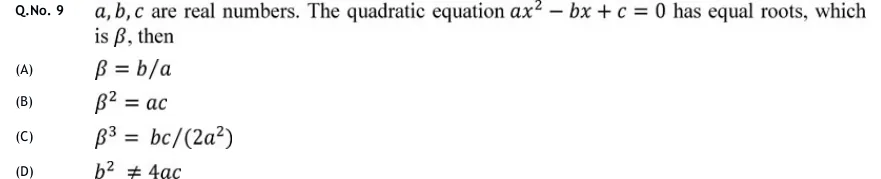
are real numbers. The quadratic equation has equal roots, which is , then
- (A)
- (B)
- (C)
- (D)

are real numbers. The quadratic equation has equal roots, which is , then
ANSWER
The answer is (C): .
Official answer: CSource: Official answer key, GATE 2020 EC (IIT Delhi)
The equation is quadratic, so . It has equal roots, which is , so both of its roots are .
Compare with the standard form . Here and .
Sum of the roots is :
Product of the roots is :
Multiply the two results: This holds for every such equation, so (C) is always true.
(A) says , but . The two agree only when , so (A) is not true in general. (B) says , but . These agree only when or , so (B) is not true in general. For example, , that is , has , while and . (C) checks out here: .
Equal roots mean the discriminant is zero: , so . That makes (D), , always false.
The only statement that must hold is (C).
KEY IDEA
For the double root of , the sum of the roots gives and the product gives . Multiplying the two gives directly.
WATCH OUT FOR
Forgetting that the two equal roots add up to , not , which leads to (A). Also: taking the sum as without noticing that the equation is written with (this flips the sign of ), or writing the product of the roots as instead of , which leads to (B).
From the GATE 2020 EC paper. Every question of this paper · Download the full paper · All 58 Numerical questions, with notes