
IAE Academy

GATE 2024 EC Q.52: solution and answer

GATE 2024 · ECQ.52 · 2 marks · MSQ

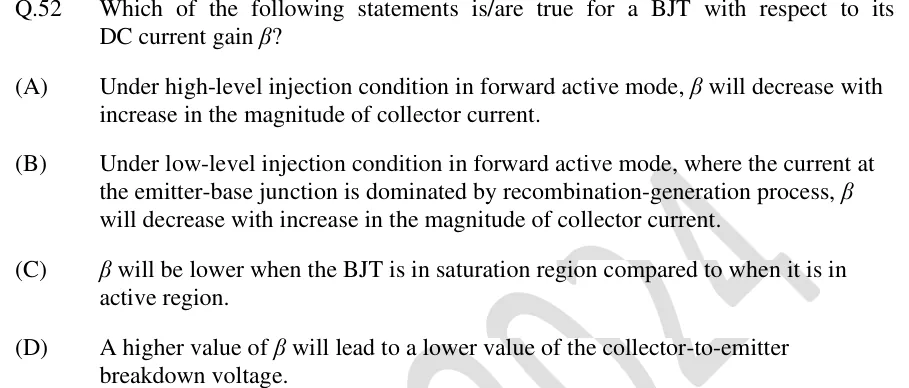
Which of the following statements is/are true for a BJT with respect to its DC current gain ?

  1. (A)

    Under high-level injection condition in forward active mode, will decrease with increase in the magnitude of collector current.

  2. (B)

    Under low-level injection condition in forward active mode, where the current at the emitter-base junction is dominated by recombination-generation process, will decrease with increase in the magnitude of collector current.

  3. (C)

    will be lower when the BJT is in saturation region compared to when it is in active region.

  4. (D)

    A higher value of will lead to a lower value of the collector-to-emitter breakdown voltage.
See the question in the paper

Answer and solution

ANSWER

Statements (A), (C) and (D) are true and (B) is false, so the answer is A, C, D.

Official answer: A, C, DSource: Official answer key, GATE 2024 EC (IISc Bengaluru)

  1. Recall the general shape of the vs curve for a BJT in forward active mode: is low at very small (base current dominated by recombination), rises to a peak at moderate , and falls again at large (high-level injection).

  2. Option A (high-level injection): when the injected minority-carrier density at the base edge of the emitter-base junction becomes comparable to the base doping , the effective Gummel number of the base increases with current, so the base current grows faster than the ideal law (the Webster effect). Since , this makes decrease as increases. (A) is TRUE.

  3. Option B (low-level injection, recombination-dominated ): here the base current is (non-ideality factor , from SRH recombination in the emitter-base depletion region), while the ideal diffusion component of (ideality factor ).

  4. As (and hence ) increases from very small values, (slope in vs ) rises faster than this recombination-dominated (slope ). Therefore increases with increasing in this regime, not decreases. (B) is FALSE.

  5. Option C (saturation vs active): in saturation both the emitter-base and collector-base junctions are forward biased, so the base current picks up an extra component from hole injection back into the collector (reverse injection across the collector-base junction) that does not appear in . This makes rise much faster relative to than in the active region, so the forced current gain in saturation is always lower than the active-region . (C) is TRUE.

  6. Option D (breakdown voltage relation): in the common-emitter (open-base) configuration, breakdown occurs when the avalanche multiplication factor satisfies (each collected carrier must, on average, generate a fresh base current carrier to sustain the loop), giving , where (typically to for silicon) comes from the empirical avalanche multiplication law .

  7. Since scales as , a larger directly forces a smaller . (D) is TRUE.

  8. Collecting the verdicts: A, C, D are true statements about ; B is false.

KEY IDEA

The vs curve of a BJT rises then falls: it is low at very small currents (base current dominated by recombination, so actually increases with there), peaks at moderate currents, and falls at high currents due to high-level injection (Webster effect). Separately, drops in saturation (extra reverse base-current injection) and a larger forces a lower through .

WATCH OUT FOR

Assuming always decreases with increasing everywhere on the curve (over-generalizing the high-injection roll-off in option A to the low-injection, recombination-dominated regime in option B), which leads students to wrongly mark B as true as well.

From the GATE 2024 EC paper. Every question of this paper · Download the full paper · All 3 BJT questions, with notes