
IAE Academy

GATE 2026 EE Q.51: solution and answer

GATE 2026 · EEQ.51 · 2 marks · MCQ

The figure shows an arbitrarily shaped planar conducting loop A in the XY plane. Two nonintersecting regions with areas and within the loop are subjected to magnetic fields , and , respectively.

What is the expression for the induced rms voltage in loop A?
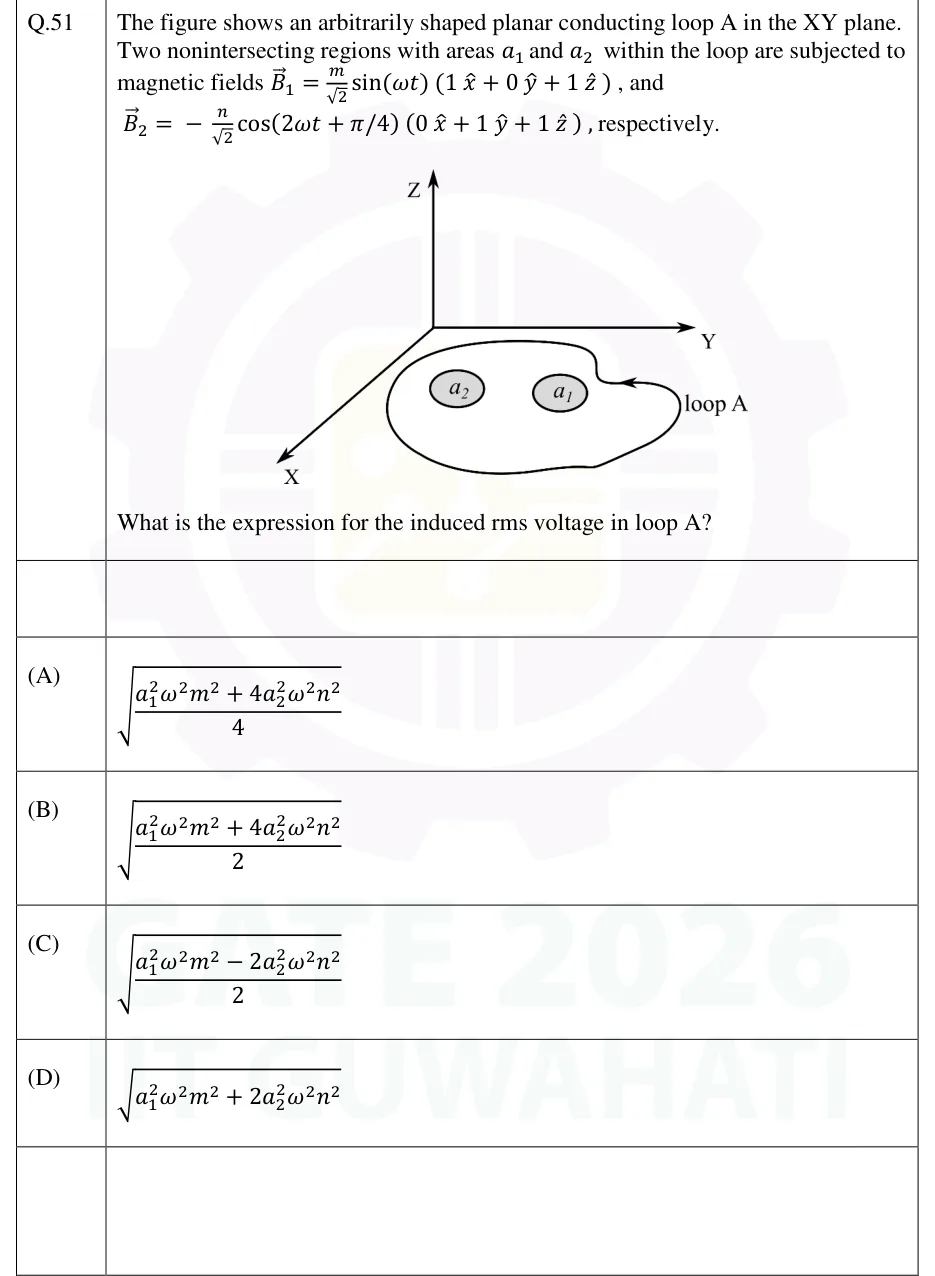
GATE 2026 EE question 51: A 3-D axis sketch with Z pointing up, Y pointing right and X pointing down-left toward the viewer, all meeting at the…Tap to open full size
Figure from the GATE 2026 EE paper. It is part of the question.
Figure description

A 3-D axis sketch with Z pointing up, Y pointing right and X pointing down-left toward the viewer, all meeting at the origin. An irregular closed curve labelled 'loop A' lies in the XY plane below the Y axis. It has a notch at the top right and a lobe extending to the right. An arrowhead on the upper edge of that right-hand lobe points left, toward the notch, and shows the direction of traversal. Inside the loop are two small, separate, grey-shaded elliptical patches side by side: a_2 on the left, nearer the X axis, and a_1 to its right. The patches do not overlap.

  1. (A)

  2. (B)

  3. (C)

  4. (D)

Answer and solution

ANSWER

The induced rms voltage is , which is option (A).

Official answer: ASource: Official answer key, GATE 2026 EE (IIT Guwahati)

  1. The loop lies in the XY plane, so its area vector is along (the sign depends on the direction of traversal). Only the -component of each field links flux: . The and components lie in the plane of the loop, so they link no flux.

  2. Take each field as uniform over its patch. The -components are and . The fluxes are therefore and .

  3. By Faraday's law, with . Since ,

  4. The two terms are sinusoids at different frequencies, and . Their peak values are and .

  5. Over the common period , the average of the cross product is zero, because sinusoids at different frequencies are orthogonal. The mean-square values therefore add: .

  6. Substituting the peaks:

  7. Therefore , which is option (A). The direction of traversal only fixes the overall sign of , so it does not affect the rms value.

KEY IDEA

A loop in the XY plane links flux only through . Faraday's law turns each patch's flux into a sinusoidal emf. Differentiating doubles the amplitude of the second term. Because the two emfs are at different frequencies ( and ), their rms values combine as , not by adding peaks or phasors.

WATCH OUT FOR

Using the full field magnitude, including the in-plane or component, instead of only . Other mistakes: forgetting the factor that the derivative of brings out, which gives option (D)'s coefficient; forgetting to divide the squared peaks by 2 when converting to rms, which leads to option (B); and treating the two emfs as phasors at one frequency and adding them.

From the GATE 2026 EE paper. Every question of this paper · Download the full paper · All 5 Maxwell's equations questions, with notes

More Maxwell's equations questions