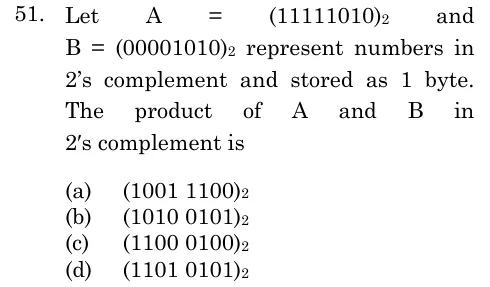
Let A = (11111010)_2 and B = (00001010)_2 represent numbers in 2's complement and stored as 1 byte. The product of A and B in 2's complement is
- (A)
(1001 1100)_2
- (B)
(1010 0101)_2
- (C)
(1100 0100)_2
- (D)
(1101 0101)_2

Let A = (11111010)_2 and B = (00001010)_2 represent numbers in 2's complement and stored as 1 byte. The product of A and B in 2's complement is
(1001 1100)_2
(1010 0101)_2
(1100 0100)_2
(1101 0101)_2
ANSWER
The product is , stored in 8-bit 2's complement as , option (c).
Official answer: CSource: ISRO's final answer key of 15 May 2026
The sign bit of is 1, so is negative. Invert the bits to get and add 1 to get . So .
has sign bit 0, so .
The product is . This lies in the 8-bit 2's complement range , so there is no overflow.
The 8-bit 2's complement representation of is .
To check by bits, write . Invert to and add 1 to get . Also , which gives .
So the product is , which is option (c).
The other options read , and as unsigned numbers. As signed 8-bit values they are , and . None of these is .
KEY IDEA
Decode each 2's complement number to its signed value, multiply as ordinary integers, check the result fits in 8 bits, then encode it back as plus the negative value.
WATCH OUT FOR
Reading as the unsigned number 250, or forgetting to add 1 after inverting the bits. Either gives a wrong magnitude for and a wrong product.
From the ISRO CS 2025 paper. Every question of this paper · The full paper (PDF, ISRO) · All 2 ISRO Number systems questions, with notes