IAE Academy

GATE 2026 CS1 Q.36: solution and answer

GATE 2026 · CS1Q.36 · 2 marks · MCQ

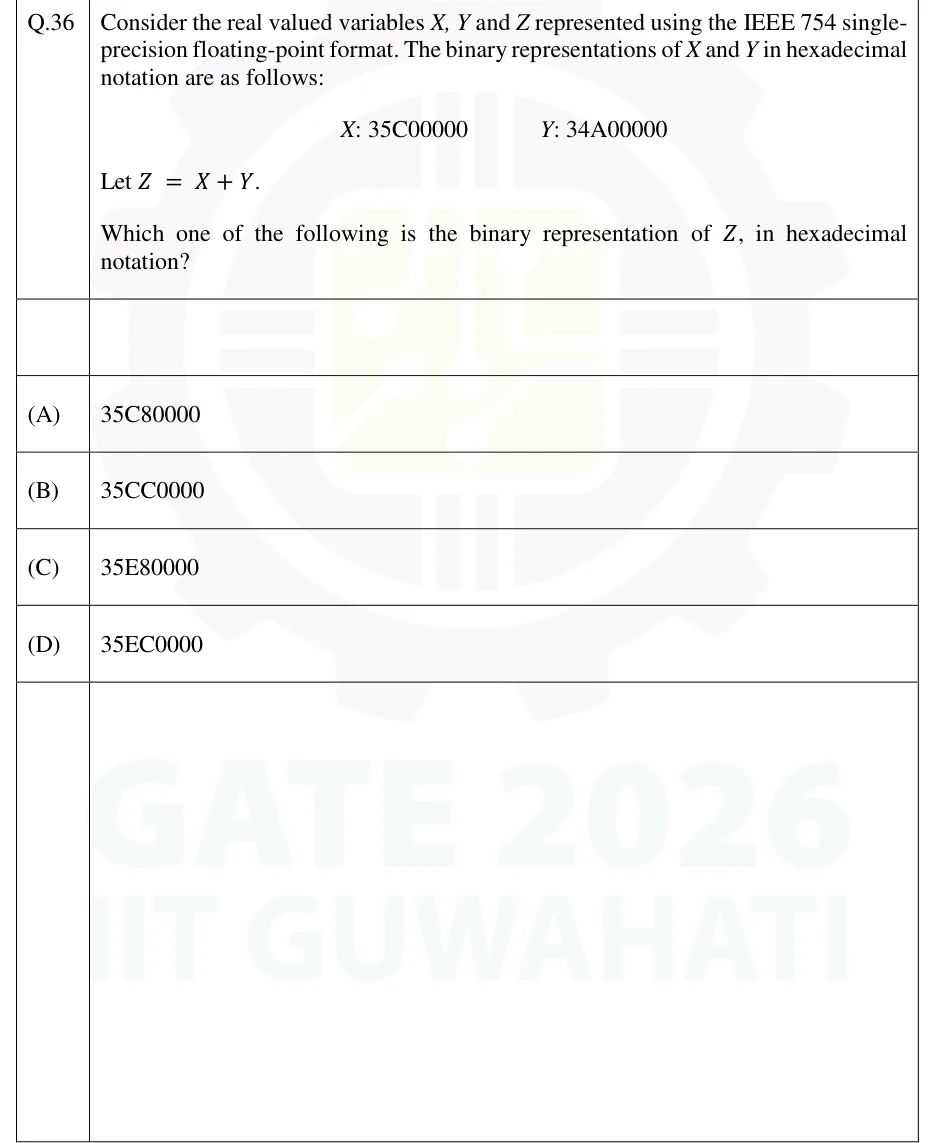
Consider the real valued variables X, Y and Z represented using the IEEE 754 single-precision floating-point format. The binary representations of X and Y in hexadecimal notation are as follows:

X: 35C00000 Y: 34A00000

Let Z = X + Y.

Which one of the following is the binary representation of Z, in hexadecimal notation?

  1. (A)

    35C80000

  2. (B)

    35CC0000

  3. (C)

    35E80000

  4. (D)

    35EC0000

See the question in the paper

Answer and solution

ANSWER

is stored as 35E80000, which is option (C).

Official answer: CSource: Official answer key, GATE 2026 CS1 (IIT Guwahati)

  1. IEEE 754 single precision: , with 1 sign bit, 8 exponent bits and 23 fraction bits.

  2. 35C00000 . Sign , exponent bits , fraction bits , so . Hence .

  3. 34A00000 . Sign , exponent bits , fraction bits , so . Hence .

  4. Align to the larger exponent: .

  5. Add the significands: , so . Since it is already normalised, the exponent field stays , and the fraction needs only 4 bits, so no rounding is needed.

  6. Assemble: sign , exponent , fraction . The bit string is , which is 35E80000, option (C).

KEY IDEA

Decode both numbers as , shift the smaller one to the larger exponent, add the significands, check that the result is still normalised, then re-encode the fraction and exponent in hexadecimal.

WATCH OUT FOR

Misreading the exponent field by one bit, because the exponent straddles two hex digits (the first bit of the third digit belongs to the exponent). A second slip is shifting the smaller operand the wrong way, or by 2 places instead of exponent steps correctly applied as a divide by 4.

From the GATE 2026 CS1 paper. Every question of this paper · Download the full paper · All 18 Number systems questions, with notes

More Number systems questions