
IAE Academy

GATE 2020 CS Q.14: solution and answer

GATE 2020 · CSQ.14 · 1 mark · MCQ

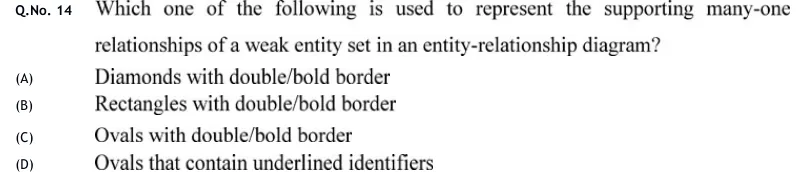
Which one of the following is used to represent the supporting many-one relationships of a weak entity set in an entity-relationship diagram?

  1. (A)

    Diamonds with double/bold border

  2. (B)

    Rectangles with double/bold border

  3. (C)

    Ovals with double/bold border

  4. (D)

    Ovals that contain underlined identifiers
See the question in the paper

Answer and solution

ANSWER

The supporting many-one relationship of a weak entity set is drawn as a diamond with a double or bold border, which is option (A).

Official answer: ASource: Official answer key, GATE 2020 CS (IIT Delhi)

  1. A weak entity set has no key of its own. Its entities are identified only through an owner (identifying) entity set, so it must be linked to that owner by a supporting relationship.

  2. The supporting relationship is many-one from the weak entity set to the owner entity set, and the weak entity set takes part in it totally.

  3. In an ER diagram a weak entity set is drawn as a rectangle with a double (or bold) border. Its supporting (identifying) relationship is drawn as a diamond with a double (or bold) border.

  4. The other options each show a different symbol. Option (B) is the weak entity set itself. Option (C) is a multivalued attribute. Option (D) is a key attribute, shown as an oval with an underlined identifier.

  5. The supporting many-one relationship is therefore shown by option (A), diamonds with a double/bold border.

KEY IDEA

A weak entity set is a double-bordered rectangle. The relationship that ties it to its owner entity set is a double-bordered diamond. Do not mix up the shape of the entity set and the shape of its relationship.

WATCH OUT FOR

Choosing (B) because "double border" is associated with weak entities. The double-bordered rectangle is the weak entity set itself, not the supporting relationship. The question asks about the relationship, which is a diamond.

From the GATE 2020 CS paper. Every question of this paper · Download the full paper · All 5 ER model questions, with notes

More ER model questions