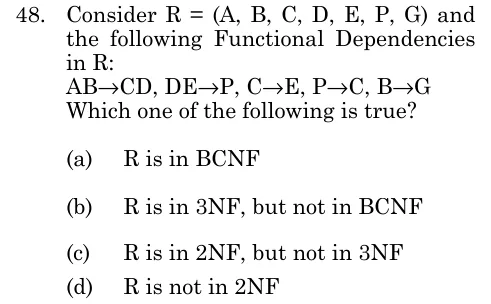
Consider R = (A, B, C, D, E, P, G) and the following Functional Dependencies in R: AB→CD, DE→P, C→E, P→C, B→G. Which one of the following is true?
- (A)
R is in BCNF
- (B)
R is in 3NF, but not in BCNF
- (C)
R is in 2NF, but not in 3NF
- (D)
R is not in 2NF

Consider R = (A, B, C, D, E, P, G) and the following Functional Dependencies in R: AB→CD, DE→P, C→E, P→C, B→G. Which one of the following is true?
R is in BCNF
R is in 3NF, but not in BCNF
R is in 2NF, but not in 3NF
R is not in 2NF
ANSWER
R is not in 2NF, because the partial dependency exists, so the answer is option (d).
Official answer: DSource: ISRO's final answer key of 15 May 2026
Find what every key must contain. and appear on no right-hand side, so no other attribute can determine them. Every candidate key therefore contains and .
Compute the closure of . Start with . Using gives . Using gives . Using gives . Using gives . So , which is all of .
Since every key contains and already determines , is the only candidate key. The prime attributes are and . The non-prime attributes are .
A relation is in 2NF when no non-prime attribute depends on a proper subset of a candidate key.
The dependency has , a proper subset of the key , determining the non-prime attribute . This is a partial dependency, so is not in 2NF.
Every 3NF relation is also in 2NF, and every BCNF relation is also in 3NF. Since fails 2NF, it fails 3NF and BCNF as well. Options (a), (b) and (c) are therefore false, and option (d) is true.
KEY IDEA
Find the candidate key by closure, then look for a non-prime attribute determined by part of the key. Such a partial dependency breaks 2NF, and so breaks 3NF and BCNF too.
WATCH OUT FOR
Spotting that and have non-key left sides and then stopping at 3NF or BCNF. The partial dependency is checked first, and it already breaks 2NF.
From the ISRO CS 2025 paper. Every question of this paper · The full paper (PDF, ISRO) · All 3 ISRO Normal forms questions, with notes