
IAE Academy

GATE 2025 EE Q.29: solution and answer

GATE 2025 · EEQ.29 · 1 mark · MSQ

The open-loop transfer function of the system shown in the figure, is

For , which of the following real axis point(s) is/are on the root locus?
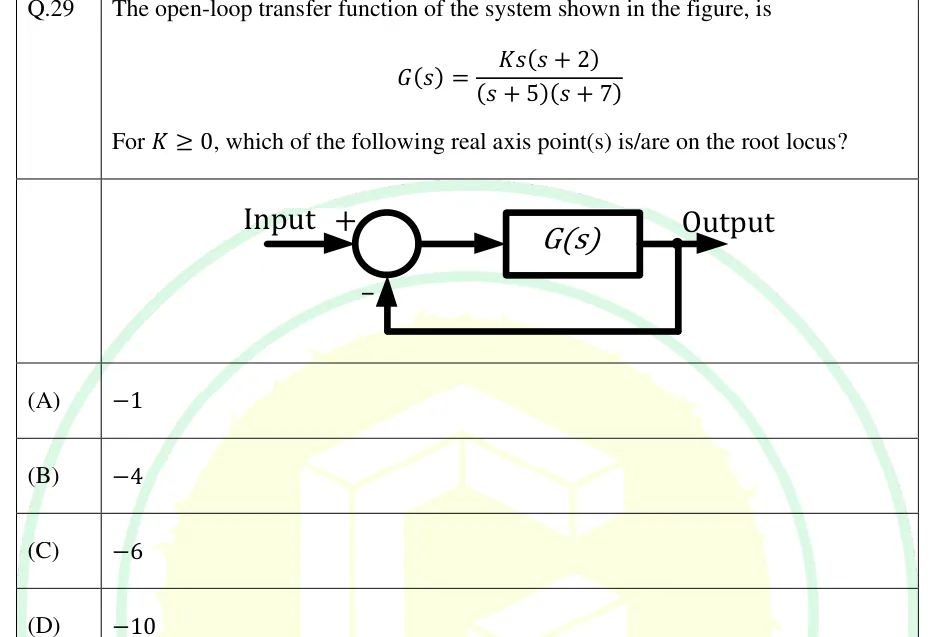
GATE 2025 EE question 29: Unity negative feedback loop.Tap to open full size
Figure from the GATE 2025 EE paper. It is part of the question.
Figure description

Unity negative feedback loop. 'Input' enters a summing junction with a + sign; the junction output feeds a block labelled G(s), whose output is 'Output'. A take-off point after G(s) feeds the output directly back (no block, unity gain) to the summing junction, entering with a - sign.

  1. (A)

  2. (B)

  3. (C)

  4. (D)

Answer and solution

ANSWER

Options A () and C () are on the root locus. The real-axis segments on the locus for are and .

Official answer: A, CSource: Official answer key, GATE 2025 EE (IIT Roorkee)

  1. The loop has unity negative feedback (the take-off after returns directly to the summing junction with a sign), so the characteristic equation is and the standard root-locus rules for apply to .

  2. Open-loop zeros: . Open-loop poles: . All four are real, so they split the real axis into segments.

  3. Real-axis rule for : a real point is on the locus if the total number of real open-loop poles and zeros to its right is odd.

  4. : one point () to the right, which is odd, so this segment is on the locus. lies here, so A is correct.

  5. : two points () to the right, which is even, so this segment is not on the locus. is not on it, so B is wrong.

  6. : three points () to the right, which is odd, so this segment is on the locus. lies here, so C is correct.

  7. : four points to the right, which is even, so this segment is not on the locus. is not on it, so D is wrong.

  8. Direct check with the magnitude/sign condition. A real point is on the locus for only if gives a non-negative :

    Only and need a non-negative , which confirms A and C.

  9. Shape check: there are two poles and two zeros, so there are no asymptotes and both branches end at the zeros and . The two branches that start at and meet in and break away into the complex plane as a conjugate pair; they cannot reach along the real axis because is not on the locus, so they re-enter the real axis in and end at the zeros. Setting with gives , so : a breakaway point in and a break-in point in , consistent with the segments found above.

KEY IDEA

For , a real-axis point lies on the root locus exactly when an odd number of real open-loop poles and zeros lie to its right. A quick cross-check is to put the point into : it is on the locus only if the that comes out is non-negative. Zeros count in the rule just as poles do, including the zero at the origin.

WATCH OUT FOR

Counting only the poles, or leaving out the zero at . If you count only poles, you shade correctly but mark every point to the right of as off the locus, so you miss . If you drop the zero at the origin, the parity flips in every segment, and you pick and instead. Another slip is to assume that the branches from and run straight along the real axis to the zeros. The segment is not on the locus, so the branches leave the axis between the poles and come back between the zeros.

From the GATE 2025 EE paper. Every question of this paper · Download the full paper · All 7 Root locus questions, with notes

More Root locus questions