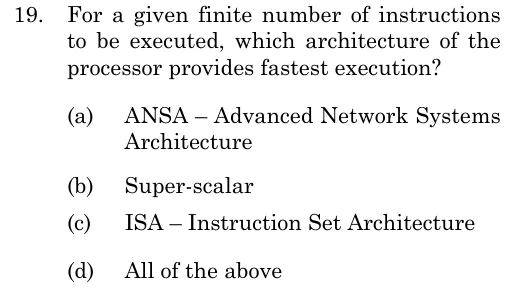
For a given finite number of instructions to be executed, which architecture of the processor provides fastest execution?
- (A)
ANSA – Advanced Network Systems Architecture
- (B)
Super-scalar
- (C)
ISA – Instruction Set Architecture
- (D)
All of the above

For a given finite number of instructions to be executed, which architecture of the processor provides fastest execution?
ANSA – Advanced Network Systems Architecture
Super-scalar
ISA – Instruction Set Architecture
All of the above
ANSWER
The answer is (b), Super-scalar.
Official answer: BSource: ISRO's revised and final answer key of 16 February 2024
For a fixed number of instructions , execution time is . With and the clock period unchanged, a lower CPI (more instructions finished per cycle) means faster execution.
A super-scalar processor has several execution units and issues more than one instruction per clock cycle. Its CPI can fall below 1 (IPC above 1), so it finishes the same instruction stream in fewer cycles than a scalar pipeline.
ISA (Instruction Set Architecture) is only the programmer-visible interface: the instructions, registers and addressing modes. It does not say how fast they execute, so it is not a speed-up technique.
ANSA (Advanced Network Systems Architecture) is a framework for distributed systems and networking, not a way of executing instructions inside a processor, so it does not speed up instruction execution.
Only option (b) names a processor architecture that speeds up execution, so (d) 'All of the above' is also wrong.
KEY IDEA
Execution time is . A super-scalar design issues several instructions per cycle, which lowers CPI below 1 and shortens the run for the same instruction count.
WATCH OUT FOR
Picking 'All of the above' because every option sounds like an architecture. ISA is only the instruction-level interface and ANSA is a networking framework; neither makes a processor execute instructions faster.
From the ISRO CS 2023 paper. Every question of this paper · The full paper (PDF, ISRO) · All 2 ISRO Pipelining questions, with notes