
IAE Academy

ISRO CS 2025 Q.41: solution and answer

ISRO 2025 · CSQ.41 · 1 mark · MCQ

Computer A is assigned with IP address 10.0.0.126 and computer B is assigned with IP address 10.0.0.131. Network mask is 255.255.255.192 in both cases. Which of the following statements is true?

  1. (A)

    10.0.0.x addresses have to be allocated by IANA and cannot be used by hosts

  2. (B)

    The given network mask cannot be assigned to class A IP addresses

  3. (C)

    A router will be required to communicate between A and B

  4. (D)

    Computer A and B form part of a multicast group
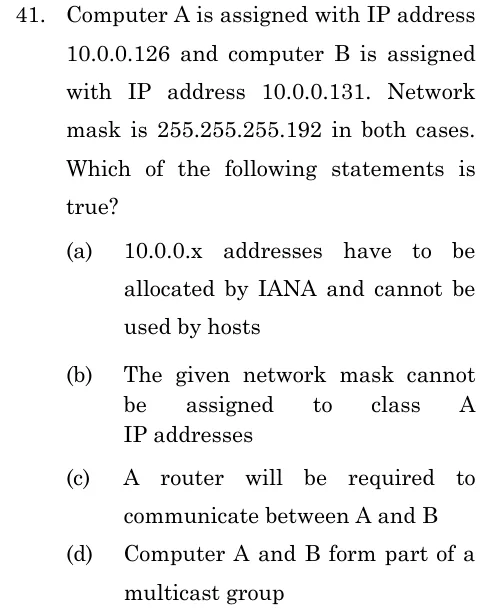
See the question in the paper

Answer and solution

ANSWER

The answer is (c): A and B are in different subnets, so a router is required for them to communicate.

Official answer: CSource: ISRO's final answer key of 15 May 2026

  1. The mask has last octet , so it has network bits (a mask). The host part is bits, so each subnet spans addresses in the last octet.

  2. Subnet boundaries in the last octet are . Two hosts are in the same subnet only if their addresses agree in all network bits.

  3. Computer A: last octet lies in to , so A is in subnet (broadcast address ).

  4. Computer B: last octet lies in to , so B is in subnet .

  5. The two hosts are in different subnets. Traffic between different IP subnets must be forwarded by a router, so option (c) is true.

  6. Option (a) is false: is a private address block meant for local use. Hosts can use these addresses freely, and no allocation from IANA is needed for each user.

  7. Option (b) is false: a class A address has the default mask , but a longer mask is allowed. Subnetting lets a class A address carry a mask.

  8. Option (d) is false: multicast addresses lie in to , and is a unicast private address.

KEY IDEA

Convert the mask to a prefix length, find the block size in the interesting octet (), and see which block each address falls in. Hosts in different blocks need a router.

WATCH OUT FOR

Assuming that because both addresses start with and share one mask, they are in the same network. The mask splits the last octet into blocks of 64, and and fall on opposite sides of the boundary at .

From the ISRO CS 2025 paper. Every question of this paper · The full paper (PDF, ISRO) · All 2 ISRO IPv4 questions, with notes