IAE Academy

GATE 2020 CS Q.15: solution and answer

GATE 2020 · CSQ.15 · 1 mark · MCQ

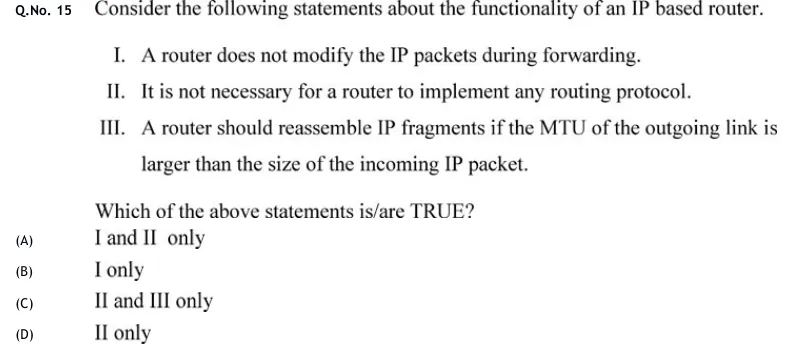
Consider the following statements about the functionality of an IP based router.
I. A router does not modify the IP packets during forwarding.
II. It is not necessary for a router to implement any routing protocol.
III. A router should reassemble IP fragments if the MTU of the outgoing link is larger than the size of the incoming IP packet.
Which of the above statements is/are TRUE?

  1. (A)

    I and II only

  2. (B)

    I only

  3. (C)

    II and III only

  4. (D)

    II only

See the question in the paper

Answer and solution

ANSWER

Only statement II is true, so the answer is (D) II only.

Official answer: DSource: Official answer key, GATE 2020 CS (IIT Delhi)

  1. Statement I: when a router forwards an IP packet it decrements the TTL field, and because the header changed it must recompute the header checksum. The packet is therefore modified, so I is false.

  2. Statement II: a router can forward packets using a statically configured forwarding table. No routing protocol such as RIP, OSPF or BGP is needed. So II is true.

  3. Statement III: IP fragments are reassembled only at the destination host. A router does not reassemble them, even when the outgoing link has a larger MTU than the incoming packet. So III is false.

  4. Only statement II is true, so the answer is (D) II only.

KEY IDEA

A router changes the TTL and header checksum on every hop, can run on static routes alone, and never reassembles fragments, because reassembly happens only at the destination host.

WATCH OUT FOR

Believing a router leaves packets untouched (forgetting the TTL decrement and checksum update), or that a router reassembles fragments when the next link has a larger MTU.

From the GATE 2020 CS paper. Every question of this paper · Download the full paper · All 20 IPv4 questions, with notes

More IPv4 questions