IAE Academy

GATE 2025 BT Q.27: solution and answer

GATE 2025 · BTQ.27 · 1 mark · MSQ

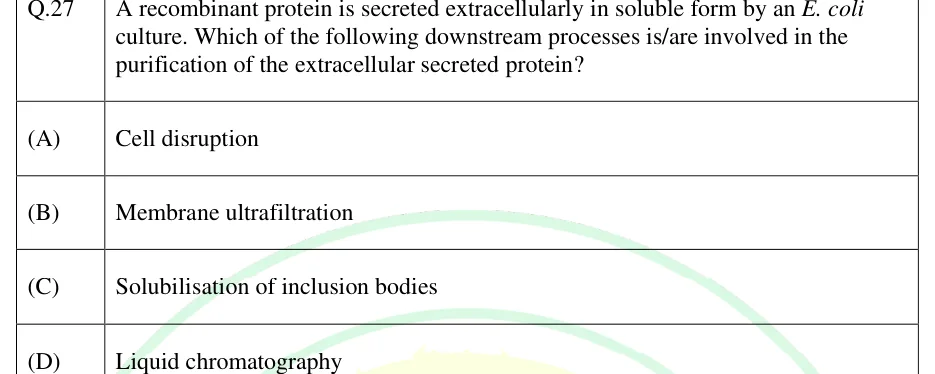
A recombinant protein is secreted extracellularly in soluble form by an E. coli culture. Which of the following downstream processes is/are involved in the purification of the extracellular secreted protein?

  1. (A)

    Cell disruption

  2. (B)

    Membrane ultrafiltration

  3. (C)

    Solubilisation of inclusion bodies

  4. (D)

    Liquid chromatography

See the question in the paper

Answer and solution

ANSWER

(B) Membrane ultrafiltration and (D) Liquid chromatography. The protein is already outside the cells and soluble, so cell disruption and inclusion-body solubilisation are not needed.

Official answer: B, DSource: Official answer key, GATE 2025 BT (IIT Roorkee)

  1. Where the product is. The protein is secreted into the culture medium. Once the cells are removed (by centrifugation or microfiltration), the product is in the clarified broth, not inside the cells.

  2. (A) Cell disruption: not needed. Homogenisation or bead milling is only useful when the product is intracellular. Here it would release host proteins, nucleic acids and cell debris into the product stream and make purification harder.

  3. (C) Solubilisation of inclusion bodies: not needed. Inclusion bodies are insoluble protein aggregates that form inside the cytoplasm. The question says the protein is secreted in soluble form, so there are no aggregates to dissolve (with urea or guanidine HCl) and refold.

  4. (B) Membrane ultrafiltration: involved. An extracellular product is dilute, spread through a large volume of broth. Ultrafiltration through a membrane whose molecular-weight cut-off is below the protein's molecular weight keeps the protein back and lets water and small solutes through, which concentrates it. Diafiltration on the same membrane then exchanges the buffer before chromatography.

  5. (D) Liquid chromatography: involved. High-resolution purification (ion-exchange, affinity, hydrophobic-interaction, size-exclusion) separates the target protein from other proteins in the broth, both secreted ones and any released by lysed cells.

  6. Downstream train: cell removal ultrafiltration/diafiltration chromatography polishing. So (B) and (D) are correct.

KEY IDEA

Where the product is decides the downstream train. An intracellular product needs cell disruption, and if it forms inclusion bodies it also needs solubilisation and refolding. A soluble extracellular product skips both: remove the cells, concentrate the dilute broth (ultrafiltration/diafiltration), then purify it by chromatography.

WATCH OUT FOR

Picking (C) because recombinant proteins made in E. coli often form inclusion bodies, or (A) because downstream processing is taught as starting with cell disruption. Both steps apply only to intracellular products. This question says outright that the protein is secreted and soluble.

From the GATE 2025 BT paper. Every question of this paper · Download the full paper · All 9 Downstream questions, with notes

More Downstream questions