IAE Academy

GATE 2019 BT Q.43: solution and answer

GATE 2019 · BTQ.43 · 2 marks · MCQ

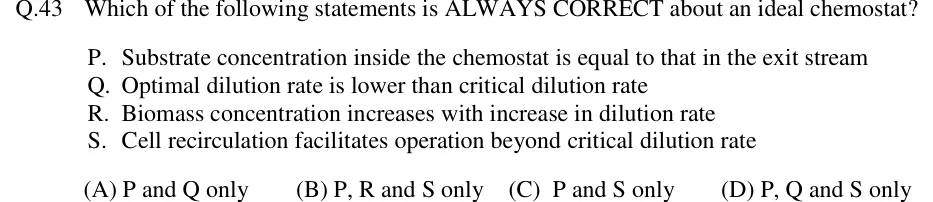
Which of the following statements is ALWAYS CORRECT about an ideal chemostat?

P. Substrate concentration inside the chemostat is equal to that in the exit stream

Q. Optimal dilution rate is lower than critical dilution rate

R. Biomass concentration increases with increase in dilution rate

S. Cell recirculation facilitates operation beyond critical dilution rate

  1. (A)

    P and Q only

  2. (B)

    P, R and S only

  3. (C)

    P and S only

  4. (D)

    P, Q and S only

See the question in the paper

Answer and solution

ANSWER

The answer is (D), P, Q and S only. P is true because the vessel is perfectly mixed, Q because is below , and S because cell recycle gives . R is false because biomass concentration falls as the dilution rate rises.

Official answer: DSource: Official answer key, GATE 2019 BT (IIT Madras)

  1. P (true). An ideal chemostat is a perfectly mixed continuous stirred-tank reactor, so the composition is the same at every point in the vessel and the outlet stream is a sample of the vessel contents. Therefore .

  2. Setting up Q and R. Take Monod kinetics, . Here is the specific growth rate, is its maximum value and is the saturation constant. At chemostat steady state , where is the dilution rate. Solving for the substrate concentration gives , and the substrate balance gives . In these, is the feed substrate concentration, is the biomass concentration and is the biomass yield on substrate.

  3. Critical (washout) dilution rate. Washout happens when no substrate is used up, i.e. . Putting into gives

  4. Optimal dilution rate. This is the at which biomass productivity is highest. Setting gives . Now put , so that . The condition becomes , so and

  5. Q (true). When , , so for every choice of , and . There is also a direct argument: productivity is zero at and zero again at washout (), and positive in between. Its maximum must therefore come before .

  6. R (false). goes up as goes up. So goes down as increases and reaches at . The statement is not always correct.

  7. S (true). Suppose a fraction of the feed flow is recycled, carrying cells at with concentration factor . The steady-state biomass balance on the vessel is , which gives . The cells therefore only need to grow more slowly than the dilution rate. Washout now occurs only when , so a steady state can be kept above the simple chemostat's .

  8. P, Q and S are always correct and R is not, so the answer is option (D).

KEY IDEA

In a steady-state chemostat . So rises with , and falls with . Productivity is zero at and at washout, so it peaks strictly below . Cell recycle keeps below , which is what lets the reactor run above the simple chemostat's washout rate.

WATCH OUT FOR

Picking R because a higher dilution rate brings in more substrate. In fact, raising forces cells to grow faster, which needs a higher residual , and that leaves less substrate to turn into biomass. The other common mistake is to confuse the optimal dilution rate (maximum productivity ) with the critical one (washout) and so reject Q.

From the GATE 2019 BT paper. Every question of this paper · Download the full paper · All 24 Bioreactor operation questions, with notes

More Bioreactor operation questions