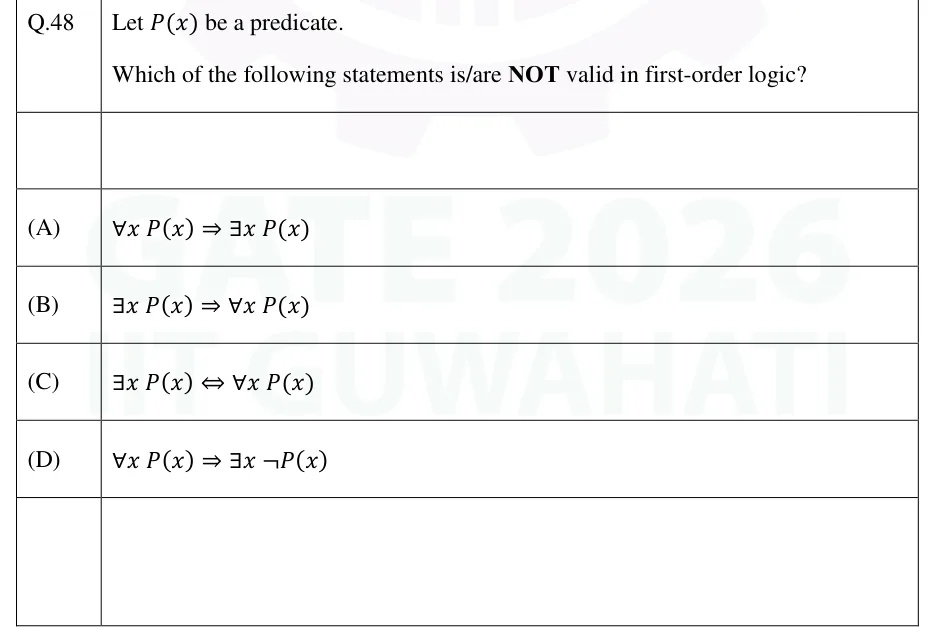
Let be a predicate.
Which of the following statements is/are NOT valid in first-order logic?
- (A)
- (B)
- (C)
- (D)

Let be a predicate.
Which of the following statements is/are NOT valid in first-order logic?
ANSWER
The statements that are not valid are (B), (C) and (D); only (A) is valid.
Official answer: B, C, DSource: Official answer key, GATE 2026 DA (IIT Guwahati)
A formula is valid if it is true in every interpretation. In standard first-order logic every domain is non-empty. We check each option for a counter-model.
(A) : if holds for every element and the domain has at least one element, then holds for some element. No counter-model exists, so (A) is valid.
(B) : take domain with true and false. Then is true and is false, so the implication is false in this interpretation. (B) is NOT valid.
(C) : a biconditional needs both directions. The direction holds, but fails in the same counter-model as in (B). So (C) is false there and NOT valid.
(D) : take any non-empty domain in which is true everywhere. Then is true, while is false, so the implication is false. (D) is NOT valid. (It is still satisfiable: it is true in any interpretation where fails for some element, because the antecedent is then false. Satisfiable is not the same as valid.)
Hence the statements that are NOT valid are (B), (C) and (D).
KEY IDEA
A formula is valid only if no interpretation falsifies it. Because first-order domains are non-empty, is valid, but and anything claiming forces each have a simple counter-model.
WATCH OUT FOR
Reading "NOT valid" as "never true", or confusing satisfiable with valid. A statement can be true in some models (as (B) and (D) are) and still not be valid. Also, forgetting that the question asks for the NOT valid ones and picking (A).
From the GATE 2026 DA paper. Every question of this paper · Download the full paper · All 7 Logic questions, with notes